
Third World War coming nuclear attack war in Belgium
World War III looming: nuclear attack war in Belgium and the Netherlands. Putin's update to the nuclear doctrine and expected terrorist attacks. Preparation and protection. Update 09/18/2026

Trump's threats weaken NATO
On one hand, American President Donald Trump has made Europe stronger, but on the other hand, NATO's credibility is crumbling due to the numerous threats against its European partners. This radiates weakness that is being exploited by the Russians!
Russian nuclear doctrine update
The update to the Russian nuclear doctrine has made it clear that Russia can be the first to use nuclear weapons!
Russian Nuclear Preventive Strike
The advantages for the Russians if they strike first with nuclear weapons or a "Nuclear Preventive Strike" are being somewhat downplayed by Western countries. But if Russia were to be the first to destroy a small, important NATO country with nuclear weapons, no one can 100% guarantee that the rest of the NATO countries will deploy the agreed-upon "Second Strike Capability" to attack Russia with nuclear weapons in retaliation. In the current relationship between Europe and America, this is even highly questionable.
Belarus and Oreshnik hypersonic missiles
The Oreshnik hypersonic missiles are considered by Putin to be a superweapon against which Europe has no protection. By firing these nuclear hypersonic attack weapons from Belarus, NATO is forced to react to Belarus and Moscow escapes a nuclear counter-response.
Some strategists argue that NATO's reaction would then be with conventional weapons, but how objective is this and how afraid is Putin of that? One could, of course, attack Russia with conventional weapons in response, such as sinking the Russian Navy, but then again, it is currently just sitting uselessly in Russian ports, so... what does it matter to Putin?
The Russian nuclear preventive strike now also stirs fear within NATO because during the Cold War, plans were in place and Russian military personnel were trained to use nuclear weapons quite early in the conflict in the event of a war with NATO. They would first attack strategic locations in Europe with nuclear weapons, which would considerably limit NATO's conventional resources. It was assumed that a nuclear attack across all of Western Europe would cause such panic that there would barely be any military resistance left. Russia would then use tanks to conquer the remaining areas that were not yet contaminated by radioactive fallout.
Attack with a nuclear EMP weapon
A new threat, perhaps even more realistic than a large-scale nuclear war, could come from an EMP weapon (Electromagnetic Pulse) that burns out all electrical components in the area. An EMP weapon can range from a man-made EMP (smaller weapons) to a military nuclear EMP weapon. A simulation of the detonation of a nuclear EMP bomb (high-altitude nuclear bomb or Russian nuclear weapons in space) shows that this could have severe consequences. Not only because the entire electrical network is completely destroyed in one fell swoop, but also due to the failure of various systems that depend on working electrical components, such as hospitals, water purification, factories, all transport, agricultural machinery, up to nuclear power plants. Repairing all the burnt-out electric motors, transformers, and electrical controls can take months. Electricity, gas, and water could be out for months in such scenarios. Hence, an emergency kit to survive for at least three days. In the event of a military nuclear EMP explosion, various weapon systems can also be severely damaged, to such an extent that the army could be completely paralyzed and lose the ability to strike back. Protect your electronic equipment such as emergency radios and generators against an EMP bomb! Wrap them in aluminum foil or store them in a grounded metal cabinet.
Attack with a nuclear torpedo
One of the latest new atomic weapons is the Russian Poseidon nuclear torpedo, which is detonated underwater off the coast of a specific country, causing a tsunami that floods the entire coastline. If a 2-megaton Russian Poseidon nuclear torpedo were to explode off the Belgian coast near Blankenberge, a tidal wave of radioactive water meters high would flood a large part of West Flanders and, via the Western Scheldt, also submerge a large part of Antwerp. An emergency flood kit is therefore a good choice for those who live by the sea.
Unattributable nuclear weapons
Unattributable nuclear weapons are portable nuclear bombs, dirty nuclear bombs, or other tactical nuclear bombs where there is no direct indication of who detonated the nuclear bomb. If a portable nuclear bomb were to explode in Kyiv or a nuclear power plant were blown up, Russia would deny they were the ones who detonated it. There would be no evidence of a missile or aircraft that launched the nuclear bomb. If one were not certain that Russia, North Korea, Iran, or another group was behind the nuclear explosion, there would be no counter-response.
If a cargo ship drops a nuclear bomb in the North Sea and detonates it only a month later, there would also be no evidence that Russia is behind the nuclear explosion, meaning there would be no nuclear counter-response.
End of START treaty on nuclear weapons between Russia and America
The end of the START treaty on nuclear weapons between Russia and America heralds a new era for a nuclear arms race. The old START treaty was already no longer being followed by the Russians and Americans. The United States wants a new treaty on nuclear weapons that also includes China, but China wants as many nuclear weapons as America and is still far from that level. Several countries want to modernize or expand their nuclear arsenals.
Putin in a corner
Ukraine is receiving technical support from a number of high-tech companies from America and Europe, allowing Ukraine's AI-powered drones to slip through Russian air defenses and cause heavy damage in Moscow and St. Petersburg. Russia is responding with heavy ballistic missiles on Kyiv.
This is an escalation, and after heavy ballistic missiles, there is only one step higher, and that is ballistic missiles with nuclear warheads or tactical nuclear weapons. Although some military strategists also suggest the option of chemical and biological weapons as an intermediate step, these do not have the shock effect of a nuclear weapon.
The advanced AI drones of Kyiv, made with Western support, put the Russians in a difficult spot, and the fear is growing that Russia will at some point resort to a nuclear weapon on Kyiv.
If Putin were to fire a tactical nuclear weapon at Kyiv, the Chinese would withdraw their support for Moscow. India and Pakistan would then also withdraw their support for Moscow. President Trump will likely not respond against President Putin, and the English nuclear submarines are in dry dock for repairs. France alone will then not respond either. If the Russians use a nuclear weapon in Ukraine, there is a good chance that, apart from some political condemnation, no one will respond militarily.
A nuclear war is impossible because…?
Various researchers argue that a nuclear war cannot break out because even the smallest use of a nuclear weapon will escalate into a larger nuclear conflict where everyone is destroyed. Unfortunately, this line of thinking only applies to rational individuals and not to impulsive individuals who might see a way out in a new apocalyptic vision where large numbers of people can be sacrificed to retain power.
So there is an advantage for the Russians in attacking first with nuclear weapons!
The chance of a nuclear conflict with Russia has never been greater.
Russia is de facto at war with NATO
According to Kremlin spokesman Dmitry Peskov, Russia is de facto at war with NATO. On Russian state television, discussions are held weekly about how to attack NATO countries with nuclear weapons. The Russian criticism that NATO would then strike back with nuclear weapons is being nuanced. The Russian population is being prepared to go along with a rhetoric of a great war with nuclear weapons against NATO. This brings Russia into a thought process where the use of nuclear weapons becomes taken for granted.
Russia may have lost many (old) tanks in Ukraine, but new tanks are rolling out of Russian weapon factories every day. In addition, Russia possesses an advantage with hypersonic missiles, while European laser weapons as protection against them are still in the development phase. The Russian defense industry has focused on the production of weapon systems that are most efficient in the war against Ukraine, such as the Geran-5 drones.
There is fearful anticipation of the year 2027, by which time not all new weapon systems will have been delivered to NATO countries and there will still be a shortage of weapons, while Russian hybrid warfare and Russian sabotage attacks on European arms manufacturers, transport, and energy infrastructure are occurring more and more frequently.
Belgium already has a new nuclear and radiological emergency plan according to the Royal Decree of June 16, 2024, where the Plan SHIELD focuses on large-scale military and hybrid threats. A new element is that Belgian Defense is now structurally and proactively embedded in the national security chains.
The updated emergency plans contain very specific and direct measures for the public. The National Crisis Center (NCCN) has launched the "Prepared Together" campaign. In this, concrete measures are expected from citizens to increase their own safety:
1- Create your own emergency plan for when a nuclear attack occurs! Citizens must make prior arrangements with family members (who will pick up the children, where to meet if the network goes down).
2- Every Belgian must have an emergency kit. The 2026 emergency kit is specifically aimed at being able to survive for 72 hours outside the home and is, just as the Belgian Crisis Center prescribes, separate from or a supplement to the home emergency kit.
Only 30% of Dutch people have items for an emergency kit in their home, and only 12% of Dutch people have a full-fledged emergency kit to survive for 72 hours!
In Belgium, this is considerably lower, and it is estimated that only 4% of the population has an emergency kit at home! There was a small increase in the sale of small emergency kits due to the promotion by the Red Cross Flanders, which brought a basic emergency kit to the market for 154.95 Euro. However, this basic emergency kit from the Red Cross does not contain water or emergency food to survive for 72 hours and therefore cannot be considered a full-fledged emergency kit. The argument that there are no ready-made emergency kits available in Belgium is complete nonsense.

link to Emergency Kits Belgium and Red emergency kits 72-hour survival
The general rule for an emergency kit is to ensure one can survive for 72 hours without electricity, gas, water, or internet. Additionally, one must take into account that payment systems may fail. Social contact with neighbors and paying with cash can already solve many problems. Keep in mind that in a crisis, everything becomes much more expensive!
3- Register for BE-Alert: Citizens are obligated/urgently requested to sign up for the national alarm system BE-Alert. In the event of a crisis, the government activates this platform to send location-based SMS messages, emails, or voice calls with direct instructions.
Other European countries are going even further with their emergency planning and are effectively preparing their population for a military conflict with Russia.
War emergency kit 2026
The war emergency kit differs from the general emergency kit proposed by Europe and contains more items for personal protection against aggression and surviving for 72 hours in a bomb shelter. The war emergency kit can be based on the current situation in Ukraine, where one can be without electricity, gas, or water for a long time. In some countries, this goes even further, anticipating a sudden, very large expansion in the number of reservists, which will lead to a major shortage of military equipment.

For Belgium, this would mean that everyone of conscription age should have their own military equipment in Multicam or Woodland camouflage in their emergency kit.
 The Multicam equipment of the Belgian Army may not be sold privately, but as an alternative, the UF-PRO equipment is of full-fledged quality and a good substitute that is widely used at the front in Ukraine.
Multicam is the new camouflage color of the Belgian Army. The Multicam camouflage color is under a US patent, is widely used for the latest types of military clothing, and is generally more expensive than Woodland camouflage. Multicam is lighter in color and fits better in dry brush and urban environments. Link to our military equipment in Multicam. Multicam is also very popular for airsoft, although a lot of imitation clothing from China is used for this.
Belgian Woodland camouflage color was and is still used to a limited extent in the Belgian Army. It is the old camouflage color of the Belgian Army that is more suitable for green wooded areas like those in Belgian meadows and forests. Many ex-military personnel or individuals who have fulfilled their conscription still have Belgian Woodland clothing at home. There is no patent on the Woodland camouflage color, and it is used a lot for simple models of clothing, making military equipment in Woodland color generally cheaper than Multicam.Link to our military equipment in Woodland. Most countries on NATO's Eastern Flank use brightly green-tinted camouflage patterns, and in the wooded areas of Norway, Finland, or the Baltic states, the Woodland camouflage pattern offers better protection than the lighter Multicam. There are currently limited series of modern military clothing on the market specifically in the Woodland camouflage color. It is clear that a military conflict in Europe will be fought sooner in the green forests on the Russian border than in the coyote sandbox of the Middle East.
Coyote color equipment is sometimes combined with Woodland equipment. Coyote is more suitable for a sandy or desert environment, such as at the coast. Link to our military equipment in Coyote.
For the purchase of a military bulletproof vest in a camouflage color, no license is required for private individuals or ordinary citizens, and it is legally permitted!
Emergency kit in two parts for 2026
The Belgian government is taking action and dividing the emergency kit into two parts. The basic emergency kit for home and an escape backpack intended to be taken along during a flight or evacuation to a safer place.

In the event of a fire, flood, or aggression, the intention is to have all supplies in an escape backpack to flee or evacuate to an emergency shelter such as a basement or underground garage, sports hall, or tent camp. With an escape backpack, one can survive independently for 72 hours, and it serves as a supplement or part of the general larger emergency kit.
German bunker plan.
The German government is already preparing the German Army and German territory for World War III and has already started a bunker plan to map out all bunkers that are still available so that the population can take shelter in the event of a war with the Russians.
For Belgium, the new government has not provided a bunker plan, and the proposed procedure is: take shelter wherever you can! There are plans where the Belgian government looks at Eastern European models such as underground garages that can function as public shelters, but this is not yet an operational, nationwide plan.
The Belgian government has already made significant investments in defense:
- A new air defense system is being purchased to protect Belgian airspace, ports, and capital cities. The new F-35 fighter jets are also a serious expansion of the Belgian Air Force's striking power.
- Belgium is being confronted with the reality of drone warfare and is responding at an accelerated pace with an anti-drone plan and the purchase of counter-drone equipment.
- The striking power of the Navy is being brought back up to standard with new frigates and expanded cooperation with the Dutch and French navies.
- The ammunition stockpile for the Belgian armed forces is being replenished. More soldiers, new aircraft, and armored vehicles. Attention is being paid to civil protection and reservists.
- The Belgian defense industry is once again being supported with investments for weapons production.
- The new Federal emergency plan is still pending, but a number of measures have already been proposed, including that every new underground garage must be reinforced and equipped with ventilation so that the underground garage can be used as a shelter or underground hospital in an emergency. (There will likely be different levels of protection, both against the direct impact of bombs and protection against a nuclear winter).
Hybrid attacks on Europe
The hybrid attacks on Europe are starting to become predictable. The Russians are taking off the gloves, and more and more sabotage acts are being carried out in Europe. The Russian GRU Unit 29155 is supported by other sabotage groups, and it is now truly leading to arson and the destruction of critical infrastructure.
Drones have become the projectiles of today! They are much more efficient than cannons or mortars. They are easily available, can be easily fitted with a bomb, and can be deployed in swarms to cause a great deal of damage. Warnings are already coming from airports, military installations, and storage facilities for fuel and toxic chemical products. Simple solutions like jamming the control signal are no longer efficient. Kinetic anti-drone weapons to shoot drones out of the sky, drone interceptors, and powerful microwave beam weapons still offer some protection against modern drones.
The Russian defense industry has focused on the production of drones that are the most efficient. Russia has not signed any arms agreements, such as the treaty against landmines or against autonomous drones. Such agreements have made the strong countries even stronger and the weaker countries even weaker. A technical evolution is underway again with AI-powered and autonomous drones.
It is not new that Russia supports terrorism and tries to encourage extreme organizations to sow unrest in Europe. Young people are also being approached to commit crimes. Although young people have little experience in the use of firearms, video games, drone flight simulators, and 3D printers can turn young people into an efficient destabilization force. Serious crimes and sabotage by young people between 14 and 16 years old are to be expected. The heavy aggressive reactions of young people under 14 years old, who committed arson and fired fireworks at emergency and rescue services on New Year's Eve 2026, should be a wake-up call.
Banks in the Netherlands are advising their customers to have some cash at home in case of a cyberattack on their payment systems. There could be cyberattacks in which hackers shut down banks, telephone, water, and electricity companies, strategic businesses, and hospitals. There is growing fear that hackers could attack the system of pumps and locks in the Netherlands, which could cause large parts of the Netherlands to flood. Be prepared for the failure of banks, shops, water, and electricity. Where will you go if the locks overflow? Do you have a backpack ready with everything needed to survive in an emergency camp, sports hall, or aid station?
Security services should keep in mind that jammers can be activated by Russian secret services, which could cut off radio communication with their security agents.
The cutting of undersea cables by ships on behalf of Russia is considered an action of the Russian Navy. NATO naval forces are already organized and are protecting the areas where strategic underwater cables are located.
Organized terrorism. In the past, it has already become clear that Russia also had a hand in certain terrorist organizations. Terrorist attacks by IS or criminal organizations through payments from Russia can no longer be ruled out. After the deadly shooting in Sydney, IS is calling for attacks in Belgium.
Manipulating information, fake news, or encouraging extreme organizations that oppose the protection of Europe or the European defense industry are a form of hybrid attack. AI-generated fake news, video, and social media are becoming a powerful weapon for the Russians.
There are already more sabotage attacks, and many more are expected! It was not logical that in the past, not a single train with military material from Europe was attacked. The hybrid attacks are increasingly resembling real military attacks. Now that various European companies are making their workshops in Europe available for the production of weapons by Ukrainian defense companies, they are becoming a new target for saboteurs on the European mainland. The Estonian Foreign Minister warns that Russian prisoners who have fought at the front in Ukraine will be sent to Europe to cause chaos and commit attacks. European security services report that the Russian Wagner Group is now being deployed by the Kremlin to commit sabotage in Europe. Quite recently, Russian ex-president Dmitry Medvedev threatened a direct attack on German arms factories.
Belgium has appointed a "drone general," and drone warfare is now a general topic in European defense.

The Belgian Army has already invested heavily in an anti-drone detection system and neutralizing hostile drones, but the concept of the resilience of the Belgian population has not yet adapted further to the changes on the drone battlefield of today. (emergency kits with bulletproof and stab-proof vests are available). More attention is being paid to the Russian FPV drones that attack unarmed civilians, and these attacks are considered war crimes. Civilians are not yet being prepared for possible attacks by small autonomous drones with explosive charges. The fear of drones among the Belgian population is increasing.

Anti-drone emergency kit Belgium 72h survival in case of a drone attack
Civilian response (resilience)
A number of people are afraid of these unknown drones. Personal protection and emergency kits are once again attracting interest.
If those drones over Belgium are carrying explosives, we have a problem!

Anti-drone protection shrapnel-resistant clothing
NATO troops not ready for drone warfare.
It looks like the NATO leadership has not closely followed the era in which warfare is evolving at lightning speed. A few years ago, there were already reports that the military training provided in Europe was inadequate for soldiers on the front lines in Ukraine?
During the NATO exercise Hedgehog 2025 in Estonia, objective training did take place, and 10 experienced Ukrainian drone pilots were allowed to attack a large NATO force of 16,000 men with dozens of armored vehicles.
From this, it became painfully clear that, in reality, NATO forces are completely unequipped and unprepared for a real drone war as it would be conducted by the Russians today. On the positive side, important lessons were learned, but those lessons have not yet reached the top of the NATO armed forces. The only soldiers who performed well were the French Special Forces, each equipped with a ghillie camouflage suit, which meant the drones could not see the French soldiers from the air.
Drones are the projectiles of today on the battlefield. They are much more efficient than cannons or mortars. No one enters a building anymore without first having a reconnaissance drone scout the building and blow up any enemy present. Technically, they are even advanced enough to have a swarm of fully autonomous drones attack an entire area.
In fact, every NATO soldier at the front should have an FPV drone and a kinetic anti-drone weapon, along with specialized gear like infrared-reflective equipment and a modified ghillie camouflage suit.
Dutch anti-drone challenge
Due to the variety of threatening drones, the Netherlands is looking for a variety of anti-drone measures, and the government has announced an "anti-drone challenge" where Dutch companies can develop their vision and innovations to combat the various types of drones. In Russia, too, most innovations in drones were developed by small companies and later adopted by large state-owned enterprises.
Also in the field of firearms and ammunition, a new company, Artillerie Inrichtingen Armaments (AIA), is active in the Netherlands to manufacture weapons and ammunition once again.
Belgium is less broad-minded, and Flanders is still struggling with the Walloon arms monopoly. The interpretation of the Belgian Arms Act in Flanders is holding back the defense industry, while the interpretation of the Belgian Arms Act in Wallonia supports the Walloon defense industry.
Protection for police and security officers.

The bulletproof vests for police are already resistant to Kalashnikov rifles but come in a dark blue color. The same bulletproof vests can also be ordered in a black color, which are then suitable for security guards and security personnel. There are new covers available for old bulletproof vests if the old vests cannot hold harder ballistic plates. The Mercury plate carrier class 4 ICW can be worn over a standard bulletproof vest as protection against war weapons.
Police services would do well to consider not setting extreme and typical Belgian technical requirements for their bulletproof vests. If requirements are too difficult, only one manufacturer will be able to make these vests, and if they cannot deliver, you will have nowhere else to turn.
For security guards, it is legally mandatory to carry a first aid kit. Some police officers also carry a small first aid kit.
For the civilian population, we recommend a discreet bulletproof vest as general protection against knife stabs, bullets, shrapnel, or bomb fragments to be better protected against terrorist attacks or drone strikes.
We reiterate that in a crisis situation, all bulletproof vests in the wholesale market will be reserved by the government, and as a civilian, it will be very difficult to obtain one. A bulletproof vest and helmet belong in your emergency kit!

The dual-use stab- and bulletproof vest MT-PRO 3A(06) GEN 7 or the slightly thinner protection FLEX-PRO 3A(06). The sturdy Patrol vest or the Rhino can also be worn discreetly under clothing.

In case of emergency, these vests can be upgraded to class 4 with hard ballistic plates against Kalashnikov rifles.

As protection against war or a terrorist attack, we recommend a full-fledged bulletproof vest with helmet, which you can now obtain with a free 72-hour emergency kit included. See also our

For parents with small children, there are also bulletproof T-shirts. These are unrecognizable to children and therefore appear as normal clothing, avoiding anxiety in children when these T-shirts are seen. There are two protection levels: the NIJ-2 comfort, which is more appreciated by women, and the Flex-Pro NIJ-3A(06), which offers higher protection.

We notice that there is more demand for bulletproof vests for children. It is logical that children should also be protected by a bulletproof vest if they accompany their parents who are also wearing one. Some of our bulletproof vests in size XSmall can be used for the protection of children from the age of 6 to 7 years old with a height of at least 1.25m. The Extra Small bulletproof vest can then be adjusted to the child's size by placing the Velcro straps at the minimum. As the child grows, the closure can be loosened further, allowing the vest to be used for several years.

As protection against arson in department stores, there are also various types of fire-resistant clothing available that can protect you from serious burns. An aramid undershirt can prevent clothing from burning into the skin, thereby limiting the percentage of burned skin and increasing the chances of surviving serious burns.

Link to stab-resistant and cut-resistant clothing
Cut-resistant clothing does not only protect against cuts from knives. The strong cut-resistant fabric also offers you a degree of protection against shrapnel from grenades or bomb fragments from FPV drones. Given that 80% of casualties in a war occur due to shrapnel from an explosion, cut-resistant and shrapnel-resistant clothing can increase your resilience.

Cut- and shrapnel-resistant combat pants
Many images are coming out of Ukraine showing soldiers with severe injuries to their feet and legs. Hand grenades or bombs dropped by drones fall to the ground and explode at ground level, causing serious injuries to the legs of soldiers and civilians. In response, cut-resistant, stab-resistant, and shrapnel-resistant pants are available, which can significantly limit injuries caused by flying shrapnel.
New views on personal protection are essential.

Link to blog about new threats
There are reports that more 9x19mm steel-core bullets are being found in criminal circles, and it could also be a form of hybrid warfare. Russian military ammunition in calibers 7.62x25mm, 9mm Makarov, 9x19mm, and 9x21mm Russian are equipped with a steel core that can penetrate the soft bulletproof vests of police or security guards. For this, one needs hard ballistic plates to be able to stop this steel-core ammunition. The current bulletproof protection level of NIJ-3A, HO1, or HO2 for personal protection must be increased to at least class NIJ-3+.

Superlight ballistic plate class 3+ PGD S-LW-ICW+

Link to class III+ bulletproof vests
This can be achieved by adding extra ballistic plates NIJ-3+ ICW to an existing bulletproof vest or by opting for NIJ-3+ Stand Alone plates in a plate carrier. A class 4 vest is an even heavier level of protection. This will also become a necessity for emergency services in the near future. New saboteurs from Russia will not use old soft lead-core ammunition but new steel-core ammunition!
President Trump and the consequences in the post-Iran war era
Things have not been going well between the Trump administration and Europe for some time now.
American ambassadors in various European countries have been instructed to import the Trump vision, and there have already been several clashes with European governments, including in France, Poland, and Belgium.
The threat Trump made against other NATO countries, such as Denmark and Canada, will not be quickly forgotten in Europe. These are not idle threats and could very well become reality.
The Trump administration is once again exerting heavy pressure on European countries to invest more in defense, especially to be able to handle a confrontation with multiple adversaries simultaneously. The war with Iran has made it clear that high-tech weapons systems are depleted very quickly and cannot be replenished rapidly. Russia has specialized in simplifying weapons systems so that they can be manufactured quickly and in large quantities. Europe must also have its share of heavy weapons systems available or be able to produce them to become a military power once again.
All European countries already have a Plan B ready in case Trump leaves NATO, but for the moment, President Trump has his hands full with his war in Iran.
Trump's unpredictability fuels Putin's aggression, and several countries on Europe's northern flank are taking far-reaching measures for the protection and resilience of their populations. Shooting training for civilians is taking place in Poland, and Norway reports that the government can requisition all goods for the military if something dramatic were to happen. We would like to point out that we offer advanced wartime emergency kits in our shop, containing numerous items for surviving in an emergency situation, whether in the case of a hybrid or military threat. In an emergency, the government will requisition all useful survival products from wholesalers for the military and police, meaning nothing will be left available for civilians! Be prepared and ensure you have a full-fledged emergency kit!

The American F-35 Lightning II fighter jet is once again being debated because all software updates are in unreliable American hands. However, even with only 80% of its electronic capabilities, the F-35 fighter is still better than all other older European fighter jets because it is virtually invisible to enemy radar. The Belgian government has decided to proceed with the order of 11 new F-35 fighter jets because it is a NATO request and because there is no alternative with similar performance. The F-35 program does not have a technical problem, but it does have a Trump problem.
Meanwhile, there are several European projects to develop a new 6th-generation fighter jet, but those projects have faced enormous delays. Belgium rightly chose the F-35 Lightning II, with the first ones being delivered as early as 2025 and the rest in 2027. Fortunately, Belgium chose the F-35; otherwise, we would have been without modern fighter jets for the next 15 years. Just as Orban lost his power overnight, the Trump threat could also be over in one night! Both England and Germany are considering purchasing even more F-35 aircraft.
Due to the Trump threat to Europe, questions are once again being raised about the European F-35 fleet. A Plan B is gradually taking shape in the form of a different European fleet of modernized Eurofighter jets, which, like the modernized American F-15EX, are a solid workhorse in the air. Spain is canceling its option for F-35 fighter jets and opting for modernized Eurofighter jets, signaling a move toward a stronger European aviation industry.
Morocco is making heavy investments in its defense industry and armed forces. The Trump administration considers Morocco an African launching pad. Morocco's behavior and the flow of refugees to Spain are a European concern.
France is quietly establishing itself as a European leader that is militarily independent of the United States and possesses its own nuclear military arsenal. There are already agreements with various European countries that are collaborating on a French nuclear umbrella, creating a European complement to the (questionable) American nuclear protection. France is stationing nuclear weapons in several European countries but retains control over the use of those nuclear weapons.
Germany has a number of large strategic American bases on its territory and, with its large defense industry, aims to become the strongest country in Europe, but it is politically quite unstable. The far-right political party AfD is gaining strength and sympathizes with Russia.
NATO has agreed with President Trump on a larger presence in the Arctic region and a permanent presence in Greenland.
Europe has shown great unity and cohesion when under significant pressure from Trump. Europe is criticized for talking too much but doing too little. President Zelensky also expresses criticism, even though he receives billions in support from Europe. Ukrainian President Zelensky is very grateful to Europe but made a number of valid points in Davos that many took the wrong way. The fact is that with Euros alone, you cannot shoot back at the Russians. Ukraine needs military hardware!
The rearmament of Europe is moving at a snail's pace. Although Mark Rutte praises the defense industry, there is a question as to why production is so slow. Only a few industrial sites were expanded with rather limited production capacity in the hands of existing arms companies, while no general production was set up. Arms production in Europe is too dependent on politics and industrial monopolies rather than military oversight and organization.
Although Mark Rutte, as NATO Secretary General, has done an excellent job of keeping NATO and Trump together, criticism of his pro-Trump attitude in Europe is growing. Mark Rutte is a master at defusing dangerous situations between NATO and Trump, but after Trump's threat of a possible military invasion of Greenland against a European NATO member, Denmark, the Belgian Prime Minister is also no longer convinced that Trump is still an ally of Europe. Mark Rutte points to the fact that Trump has made NATO stronger and radiates unlimited confidence in Trump, but because Trump has threatened Europe with military violence, the trust in America has been seriously violated.
There is a growing desire among many European countries to also have a European pillar within NATO or some form of standing European military force under a European Security Council, separate from the Americans. A European military force with European weapons that cannot be disabled with the snap of an American finger. The fact that American President Trump has threatened another NATO country with military violence for weeks is, for many European countries, a red line that has been crossed and to which a military answer must be found. A number of European leaders disagree with Mark Rutte's stance that Europe cannot defend itself and should otherwise just keep dreaming. Even the President of the European Commission, Ursula von der Leyen, responds with, "Dear Mark, there are various levels to which Europe can defend itself." Perhaps not 100%, but every day more...
America remains the greatest military power, and Europe will fight back when it is truly under pressure.
Several European countries are bringing their gold reserves back from American banks due to the unpredictable behavior of American President Trump. This is a financial signal that European banks no longer trust America and the Trump administration, causing the dollar to weaken.
As a result of the American trade war and Trump's military threat to attack a European country, Europe is looking for other trading partners and is concluding a mega-trade deal with India. The Trump administration is dissatisfied and surprised that, after American threats, Europe is seeking out other, friendlier trading partners.
Europe and Ukraine
The accession of Ukraine to the European Union and NATO is still being blocked by a number of countries. The fact is that Ukraine currently has the most experience in defending itself against Russian aggression and protection against drones. The Ukrainian armed forces are now helping NATO with realistic training in modern drone warfare and are also helping the European arms industry better prepare for a war economy. There is, therefore, broader cooperation between Europe and Ukraine.
Peace in Ukraine
Hard work is being done to bring about a ceasefire and peace in Ukraine, but it is becoming increasingly clear that this is pointless. Putin has since openly declared that he will not give up his ideals. Moscow would be too close to the new borders with NATO, and accepting this would be a strategic defeat. In reality, Russia does not hold all the territory needed to secure Moscow. Russian attacks on Kharkiv, Sumy, and Chernihiv have failed in the past.
To achieve peace, President Zelensky would have to cede large parts of Ukraine to the Russians, but even then, it is doubtful whether Putin only wants a buffer zone in Ukraine. Peace negotiations are meaningless without the capitulation of the Ukrainian army.
Russia is expanding its war economy and rebuilding its lost material, far more than what they would need to win the war in Ukraine. In fact, these new weapons have become more modern and are not even going to the front in Ukraine. Putin is keeping the battlefield warm with old Soviet weapons and sending his newest weapons to the NATO eastern flank, threatening the Baltic states with a new troop buildup.
A victory for Putin in Ukraine would pave the way for an attack on Europe. European countries realize that they must continue to support Ukraine because they are not ready for a direct war with the Russians. If the war is not fought in Ukraine, then it will be fought on the European mainland. A number of European countries see this as strategically important to pin down the Russian army in Ukraine and are providing Ukraine with their own modern weapons taken from their national military stocks.
Predictions and hypotheses
To what extent predictions are credible we will leave aside, but several seers speak of an assassination attempt on Russian President Putin and the outbreak of a war in Europe. An assassination attempt on Putin would occur because people find him too weak and unwilling to resort to nuclear weapons. The takeover by a deranged Russian general would lead to a (limited) nuclear conflict in Europe.
Russia, North Korea, Iran, and China
The war in Ukraine is no longer regionally limited. Russia is uniting its allies North Korea, Iran, and China into a military partnership. The Chinese defense strategy, in which a hybrid war against the West has actually been waged for years, and their military buildup with preparations for a military conflict, are becoming increasingly visible. Both economic activities, trade, and the accelerated large-scale expansion of their military capabilities are part of the Chinese defense strategy. China has cornered the production of a large portion of strategic goods while Europe paid no attention. The military exercises and preparations can be seen via satellite, with the result that the Americans are also preparing for a military conflict with China. It is expected that the Russian and Chinese cooperation will be further expanded and strengthened.
It is clear that America can only limit itself to a military conflict in the Middle East and the South Pacific. In the war with Iran, American weapon stockpiles have dwindled to such an extent that there is already a fear of a weapons shortage should a military conflict break out between Russia and NATO. The stock of high-tech weapons is very small, and the production time is long. Europe has only a small stock of high-tech weapons.
A further conflict with the Russians will have to be fought by the Europeans. Hence, the third world war is getting ever closer.
Opening a second front with an attack on Eastern Europe
The Baltic states, Finland, and Poland point to the large troop buildup on NATO's eastern flank and warn that the Russian armed forces are now ready to open a second front. The "little green men" who previously conquered Crimea are already appearing on the border with Estonia. An attack on the NATO eastern flank would bring arms shipments to Ukraine to a halt and give the Russians the chance to defeat the Ukrainian army.

Red line as the minimum reaction time to be able to protect Moscow against attacks from NATO. Yellow line is the desirable reaction time to be able to protect Russia against NATO.
Here it becomes immediately clear what is at stake. The north of Ukraine, the east of Latvia, Lithuania, and Estonia are just as dangerous for Moscow as Ukraine and are too close to Moscow. They pose a strategic danger to the Russians, which, according to them, must be neutralized. It is desirable for the Russians to have an even larger portion of the NATO eastern flank under their control. In this, Poland, as a NATO country, is the strongest nation that can offer the most resistance and, logically, would have to be dealt with first. Romania is another NATO country that poses a threat to the Russians. Recent Russian drone incidents over Poland and Romania indicate that Ukraine is not Putin's end goal.
Opening a second front in Eastern Europe does not have to be large-scale immediately. A number of aggressive border violations in the Baltic states would lead to an immediate panic reaction within NATO and provoke a major troop buildup on the eastern flank. This would cause a large European arms shipment to Europe's eastern flank and bring arms shipments to Ukraine to a halt.
Recent violations of NATO airspace by Russian fighter jets and drones, combined with the construction of several secret drone bases for long-range drones, make it clear that the entire NATO eastern flank can be targeted by Russian drones. The number of drone incidents is increasing, and the confrontation with NATO forces is escalating.
Is Russia too weak to open a second front?
- The Western propaganda that the Russians are out of weapons does not hold up, especially because the Russians are supported with weapons and even manpower from Iran, North Korea, and China. Every week, new records are broken for the number of drones fired at Ukraine.
- The propaganda that Russia can no longer survive economically is nonsense. The Russian population will adapt to the difficult economic circumstances and the inconveniences while supporting the motherland. Russians are extremely patriotic!
- The large number of Russian casualties makes little impression on Putin. First of all, Putin denies that he is responsible for those casualties, and besides, Russia has different standards than Europe. In the Battle of Stalingrad, there were 1.1 million Russian casualties just to recapture one city!
- The Russian army is innovating and is far advanced with new drones, new missiles, and new tanks. The Russian army that people still know is the old Soviet army.
Opening of a third front from the Russian Kola Peninsula

The Russian threat in the Arctic region comes mainly from the many nuclear bases on the Kola Peninsula, where the Russian nuclear submarine fleet and Russian nuclear ballistic missiles are stationed.
Norway fears that Russia could open a third front because there are many military bases in the north of Norway that are the first to detect Russian nuclear submarines and ballistic nuclear missiles. The Russian nuclear submarines coming from the Kola Peninsula wanting to sail into the Atlantic Ocean are vulnerable in the narrow passage between the Arctic ice and the northern coast of Norway.
Norway fears that the Russians will invade the Norwegian border to overpower the military installations that can inflict damage on the Russian nuclear submarines and ballistic nuclear missiles. The objective of the Russian nuclear submarines would be to sail from the Kola Peninsula along the Norwegian coast, past the northern coast of England and Ireland, and also through the North Sea to the Atlantic Ocean, where they could cut Europe off from American military logistical support.
Since Finland has joined NATO, they now possess the longest border with Russia. A massive Russian troop buildup along the Finnish border is to be expected.
Nuclear attack and war in Belgium
Once the NATO eastern flank is involved in a war with the Russians, all of Europe will become a target, where European energy and transport infrastructure will be the victim of sabotage acts. If Russia can no longer master the situation on the battlefield with conventional weapons, there is a good chance that tactical nuclear weapons will be used.
- Belgium is a central transit country within Europe and its strategic locations can be attacked.
- The Belgian Army is active within NATO on the Eastern Flank, and they can inflict a painful blow on the Russians with modern weapons, which could result in a counter-reaction in Belgium.
- Belgium is also a financial center that holds Russian money. Seizing those Russian assets could trigger a military reaction.
Belgium deludes itself that no Russian tanks will drive through Brussels and pretends that Belgium has never experienced a battle. (The Battle of Waterloo, The Battle of the Yser, The Battle of the Ardennes), while Russian, North Korean, and Chinese soldiers are fighting on the edge of Europe with Iranian weapons. All the Leopard tanks that Europe donated to Ukraine have since been reduced to scrap. Drones and drone motherships are the current weapons that can reach Brussels and can even be deployed completely autonomously. Do not forget that during the Cold War, Russia had a plan to conquer Europe by first attacking major European countries with nuclear weapons, and Brussels was one of those nuclear targets.
It was suggested that Russia could be at war with NATO within 5 years. Recent reports from intelligence services see a major troop buildup on the eastern border with NATO. According to the German intelligence service, Russia is finished with the troop buildup and could already carry out an attack on Estonia, Finland, and the Baltic states. The longer Russia waits for an attack, the stronger the NATO eastern flank becomes.
The major troop buildup on the Eastern Flank of NATO was to be expected, but combined with threatening language from Belarus, this also indicates that the ideal period to attack Europe will be in 2026-2027, when Europe is still busy expanding its defense and is not yet ready for a war. Within three to four years, NATO will be so strong that a Russian attack on Europe will no longer have a chance of success.
With the current escalation of Russian hybrid warfare, Germany in particular is being pressured with sabotage attacks on the electricity grid and aviation. Belgium, together with the other NATO countries, supports Germany's resistance against the Russian threat. The Belgian electricity network is very vulnerable, and in reality, one only needs to attack a small number of nodes in the high-voltage grid to leave all of Belgium in the dark or in the cold. Also consider that a prolonged power outage will have severe consequences for industry and food production. Are you ready with your emergency kit to survive a power outage of several days this winter? Check the expiration date of your canned food! Do you have an emergency stove at home to prepare some hot food? Belgium and many other different European countries are working together on the French nuclear umbrella. A nuclear attack on Belgium would be answered with a Franco-European nuclear counterattack, making nuclear deterrence credible again.
Exodus
If there is a serious risk of a nuclear war in which capitals such as London, Berlin, Paris, and Brussels would be hit, an exodus of refugees will arise who will flee these countries. For Belgium and the Netherlands, that escape route will go south via Southern France, Switzerland, and Italy to the Mediterranean Sea and from there towards North Africa. A portion of these refugees will go to Spain and Portugal and further on to Morocco. Given the drought in North Africa, some Belgians will also go to the Congo to survive the nuclear winter in Europe. There are no known preparations in which the Belgian government would guide fleeing Belgians or help boost drinking water and food production in Southern Europe or Africa. Belgium is, however, still active in supporting the Congo.
National Crisis Center in Belgium
Belgium has a National Crisis Center where all kinds of advice on various emergency situations is provided. The page Your own emergency plan can be of vital importance if a serious threat arises. There is a new National Emergency Plan at the Ministry of Defense, but concrete measures such as a bunker plan are not yet publicly known.
Think ahead in the Netherlands
In addition to impressive investments in defense, the Dutch government also has a page online with all kinds of information on how you can prepare for a crisis and what to do in the event of a nuclear accident. The Netherlands is releasing an information booklet on how to prepare for an emergency situation.
Protection of the North Sea?
Despite the many threats from Russia and the clear military cooperation with North Korea, Iran, and China, Russian and Chinese ships regularly pass through the North Sea. Reports that container ships are being converted into drone motherships, small accidents including the cutting of internet cables in the Baltic Sea, and clear underwater espionage activities have not yet led to the closure of vital locations in the North Sea to shipping traffic from countries that openly threaten Europe.
Finland, as a new NATO country, reacts extremely efficiently to sabotage actions by the Russian shadow fleet in the Baltic Sea, to the extent that they are beginning to play a leading role in preparing for better protection of their territory against a possible military conflict with the Russians. Not only the cutting of cables but also environmental sabotage, such as the detonation of an oil tanker in the Baltic Sea, is a major concern for the Baltic states.
The British are also becoming very active and realize that England is an island that imports a great deal of strategic goods via underwater cables and pipelines in the North Sea. Sabotage in the North Sea, such as cutting internet cables, would shut down all banks in England; cutting gas, oil, and electricity pipelines would shut down the majority of English companies, with the severe consequence that the entire English economy would grind to a halt.
The sabotage of German navy ships, where metal filings were poured into engines to prevent them from sailing, clearly indicates that a naval battle is being prepared by the Russians.
Russian attack from the North Sea
The attack with the new Russian Oreshnik hypersonic missile is actually no surprise anymore. The use of Iranian Shahed drones is only pinpricks that mainly scare the population in Kyiv and other cities. It could get much worse for Kyiv if the Russians fire heavy long-range ballistic missiles at the city. To what extent Oreshnik hypersonic missiles could be intercepted over Europe is not yet clear.
A Russian attack from the North Sea has a better chance of success. Although Belgium and the Netherlands are working hard on a new navy to repel a Russian attack, it may take a few more years before the new frigates and air defense are ready.
A Russian submarine limps home and sails close along the coast of European countries. To what extent this situation can be considered merely a technical defect is unclear, but the fact remains that a Russian submarine can sail close along the European coast without any problems using an excuse, and in less than one minute, fire its 24 strategic missiles before a European patrol ship can respond to it.
Perhaps no old Russian tanks will drive through Brussels, but the Ukrainian "Spider’s web" drone attack proves that one will have to be more open-minded in the future. It is very simple to equip a Russian or Chinese container ship with thousands of drones and then release them off the Belgian coast.
Future of NATO
The heated atmosphere within NATO over Greenland has cooled somewhat due to actions and dialogue within the involved NATO countries. The new heated atmosphere caused by the American attack in Iran is pulling the rift in the relationship between Europe and America further open.
The fact is that the threats from Russia and China are serious, and a serious response is being sought within NATO.
The Trump administration is putting great pressure on Europe with both economic and military threats to encourage Europeans to invest faster and more in defense.
America wants its European allies to become stronger and be able to provide for their own security. The main threat for America is China in the Indo-Pacific and Russia in the Arctic region.
The harsh American threats against Europe are interpreted in some countries as meaning that America is already becoming a threat in second place after Russia.
NATO is strongly expanding its military capabilities and is still doing so together with America, but Europe is gaining more responsibility for its own defense. A portion of Europeans no longer trusts the Trump Administration after the repeated threats of military intervention against Greenland and Denmark.
The idea of a European Defense Union with a focus on the European defense industry and joint military acquisitions is a realistic scenario.
An alternative European nuclear strike force based on French nuclear power and French fighter jets is also a realistic scenario.
The threats from America to Europe are making NATO weaker due to the major division. Europe is facing a major challenge, because the naive pacifism that caused under-armament in Europe is not gone. The division within NATO is growing with a group of strong, reliable countries that take defense seriously and another group that are unpredictable.
Equipment for volunteers.
If a bunker plan is implemented in Belgium or the Netherlands, volunteers will also be needed to manage everything properly. An expansion of volunteers from civil protection, reservists, stewards, etc. For these first responders, special equipment will have to be provided.
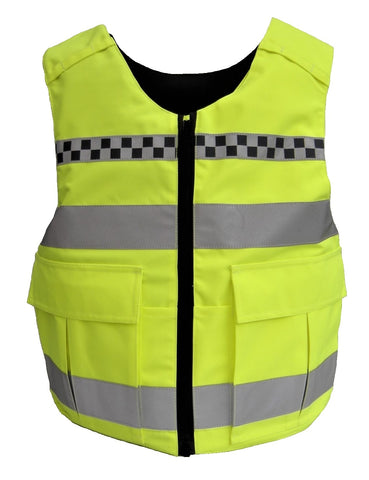
Highly visible bulletproof vests for stewards and first responders
but if saboteurs are active in major cities with Kalashnikov rifles, one needs at least a Class 3+ or Class 4 plate carrier. These also already exist in a first responder version.

Medic plate carrier class 4 against war rifles
Medical plate carrier for emergency services as protection against Kalashnikov rifles.

Multicam bulletproof plate carriers class 4
In some countries, plans are already underway to enlist licensed sport shooters as reservists. It is estimated that 1/3 of sport shooters could be eligible for this. The goal of these reservists would be to take over guarding duties from professional soldiers. In Belgium, approximately 15,000 sport shooters would be eligible to become reservists in this way.
What color uniform will these reservists wear? Multicam is a U.S. patent that requires extra payment. Woodland is widely available among the population and is not patented, making it more abundant and cheaper.

Black bulletproof vests for security services and civil defense

Bulletproof vests with shoulder, neck and groin protection for civilians

Bullet- and fragment-resistant vests against attacks by armed drones