
Reload data 30 Super Carry and 7.92x24mm comparison
Reload data 30 Super Carry and 7.92x24mm comparison. Effect of high chamber pressure vs high case capacity. Reloading dies load .312 Hornady XTP (85 grains). Body armor to stop these bullets.
Introduction
The nomination of the new .30 pistol (PDW) calibers.

Both calibers 30 Super Carry and 7.92x24mm using basically the same .32 caliber bullets. The .32 caliber is for most people in the United States related to the .32 ACP cartridge and in Europe to the 7.65 Browning cartridge. Although the 7.65 Browning was a revolutionary cartridge at its time and was used in many old military pistols, according to modern standards the .32 ACP caliber is generally considered underpowered and too weak for personal defense. To prevent a negative association with the underpowered .32 ACP / 7.65 Browning cartridge, the designers opted for a different nomination.
In Europe, to prevent the association with the 7.65 Browning, VBR-Belgium chose the effective diameter of the .312 bullet, which is 7.92mm, and according to the metric system nominated the caliber 7.92x24mm (2).
In the United States, to prevent the association with the .32 ACP cartridge, Federal Premium Ammunition chose the barrel nomination as a .30 barrel and its target audience the .30 Super Carry (3).
The positioning of the 30 Super Carry and the 7.92x24mm

1) 9x19mm NATO cartridge
2) 7.92x24mm (S) Short cartridge
3) .30 Super Carry cartridge
4) 7.92x24 mm (N) Normal cartridge
5) .45 ACP cartridge
While the 30 Super Carry (3) is intended for use in the 9x19mm (1) frame platforms. The 7.92x24mm N (4) was intended for the .45 ACP (5) frame platforms. Only the 7.92x24mm caliber was designed from the beginning to function in an interchangeable multi-caliber role in both 9x19 and 45 ACP frames by giving the bullet a deeper seating depth which resulted in the 7.92x24mm S (2) cartridge.
Reloading data comparison

At this moment there is little to no data available about the performance of specific loads from certain pistols and specific barrel lengths with the 7.92x24mm and 30 Super Carry. However, regarding the available data, certain conclusions can already be made. Warning, reloading near maximum allowed pressure, unknown tolerances may cause dangerous overpressure!
Different maximum allowed chamber pressures!
The maximum allowed chamber pressure for the 30 Super Carry is 52,000 psi. This is in line with the 5.7x28mm caliber (50,038 psi).
The maximum allowed C.I.P. chamber pressure for the 7.92x24mm is 46,412 psi. Since the 7.92x24mm case is a shortened .30 carbine case, the same maximum CIP allowed chamber pressure as the .30 carbine was chosen (46,410 psi). This is already a lot more than what the 9x19mm (34,084 psi) allows, and in a multi-caliber role, not all pistols have the same strong construction behind the breech face. At this moment there is no technical information about 7.92x24mm+P loads or the military loads which are not bounded by the C.I.P. specifications.
The 1911 pistol frame platform.

The reloading data and shooting performance are both based on a 1911 pistol which has the same strong construction. For the 30 Super Carry these performances are achieved with a Nighthawk Custom 1911 with 5” barrel, and for the 7.92x24 mm N these performances are achieved with a PSW Multi caliber 1911 with a 4” barrel. This is not exactly the same but it gives an impression of the velocity relative to the chamber pressure.
Same bullet Hornady XTP (85 grains)
Since the 7.92x24mm N and the 30 Super Carry can use the same Hornady XTP (85 grains) bullets, this proves how closely they are related to each other.
Source:
Handloader TV / .30 Super Carry Handloads - Nighthawk Custom 1911
https://www.youtube.com/watch?v=5cY6NyV-EWM
Data:
Nighthawk Custom 1911 with 5” barrel
Cal. .30 Super Carry
Bullet: .312 Hornady XTP (85 grains)
Powder: Accurate No. 5 (5.7 grains)
Primer: CCI 500
Brass: Federal (once fired)
Maximum average Pressure allowed 52,000 psi
COAL: 1.085” (27.55 mm)
Average velocity: 1317 fps - 401 m/s
Source:
VBR-Belgium reloading data
Data:
PSW Multicaliber 1911 with 4” barrel (Commander)
Cal. 7.92x24mm N (Normal) VBR-B
Bullet: .312 Hornady XTP (85 grains)
Powder: Vihtavuori N320 (5.4 grains)
Primer: CCI 500
Brass: Remington-Peters .30 Carbine shortened to 24mm
Maximum average Pressure allowed 46,412 psi
COAL: 1.264” (32.11 mm)
Average velocity: 1379 fps - 420 m/s
Comparison
With the same .312 Hornady XTP (85 grains) bullet, and despite the higher chamber pressure (52,000 psi) of the 30 Super Carry and the longer 5” barrel, the 7.92x24mm N cartridge with a lower chamber pressure (46,412psi) and only a 4” barrel achieves an even 1379 - 1317 = 62 fps higher velocity.
Although differences in propellant can cause differences in velocity, this comparison proves that the 30 Super Carry's performances are almost identical to the 7.92x24mm N VBR-B cartridge.
High Chamber Pressure vs Usable Case Capacity.
With the same length of the .312 Hornady XTP (85 grains) bullet, the short overall length (1.085”/27.55 mm) limits the Usable Case Capacity of the 30 Super Carry, leading to fast high pressures. The 7.92x24mm N has a longer overall length (1.264”/32.11 mm) and has a significantly larger Usable Case Capacity remaining, which reduces the peak pressure in the chamber but ignites a larger amount of propellant, resulting in a higher velocity.
Nighthawk Custom 1911 with 5” barrel in 30 Super Carry
The Nighthawk Custom 1911 with 5” barrel may be a fantastic pistol, but the short 30 Super Carry is underpowered compared to the 7.92x24mm N caliber to be used in a full-size 1911 frame pistol. If the .30 barrel had been installed in a full-size 1911 - 45 Nighthawk Custom frame, the performances would be even better and the pistol would have more punch to flip over the steel targets.
Interesting gadgets
Chamber reamers for the 7.92x24mm
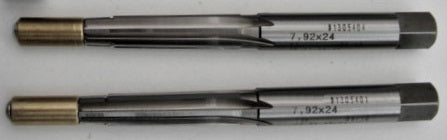
Reloading dies 7.92x24mm

Level of body armor needed to stop a 7.92x24mm or 30 Super Carry bullet
Since the calibers 7.92x24mm and 30 Super Carry use the same type of bullets at similar velocities, it is to be expected they have the same behavior against soft body armor. .

Although there is not yet official NIJ certified body armor against the 7.92x24mm and 30 Super Carry cartridges, the energy level is at the level of the 7.62x25mm Tokarev. While not all NIJ-3A body armor can safely stop the 7.62x25mm Tokarev, we can say that all bulletproof vests certified against the 7.62x25mm Tokarev are the most suited to stop bullets from 7.92x24mm and 30 Super Carry pistols.
Lightweight .312 full metal jacket bullets are composed with a soft lead core that can be stopped by most types of Level NIJ-3A + 7.62x25mm Tokarev body armor.
Hollow-point bullets are forbidden by law in most European countries. Where they are allowed, as in the United States, the weaker hollow-point tip expands quickly on impact, which reduces drilling performance. Also, most types of Level NIJ-3A + 7.62x25mm Tokarev body armor can stop 7.92x24mm and 30 Super Carry hollow-point bullets.

Cast copper-plated bullets are significantly cheaper, but to withstand the high velocity, these types of .312 bullets need to be cast with a hard lead alloy. These bullets deform less and penetrate deeper into soft body armor. A Level NIJ-3A + 7.62x25mm Tokarev is the absolute minimum.
Engarde® FLEX-PRO™ bullet proof vests

Engarde® Deluxe FLEX-PRO™ concealed bullet proof vests

Deluxe FLEX-PRO black bullet proof vest
Deluxe FLEX-PRO white bullet proof vest
Deluxe FLEX-PRO blue bullet proof vest

Engarde® T-shirt FLEX-PRO™ concealed bullet proof vests
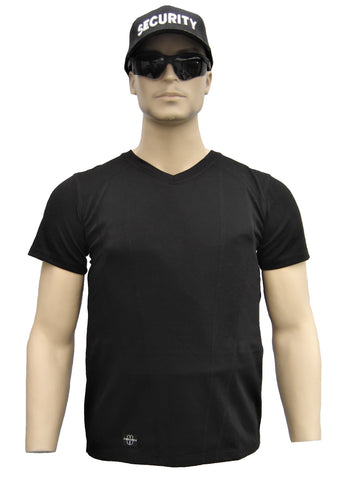
T-shirt FLEX-PRO black bullet proof vest
.
Visitors from the USA interested in body armor please visit Engarde USA