
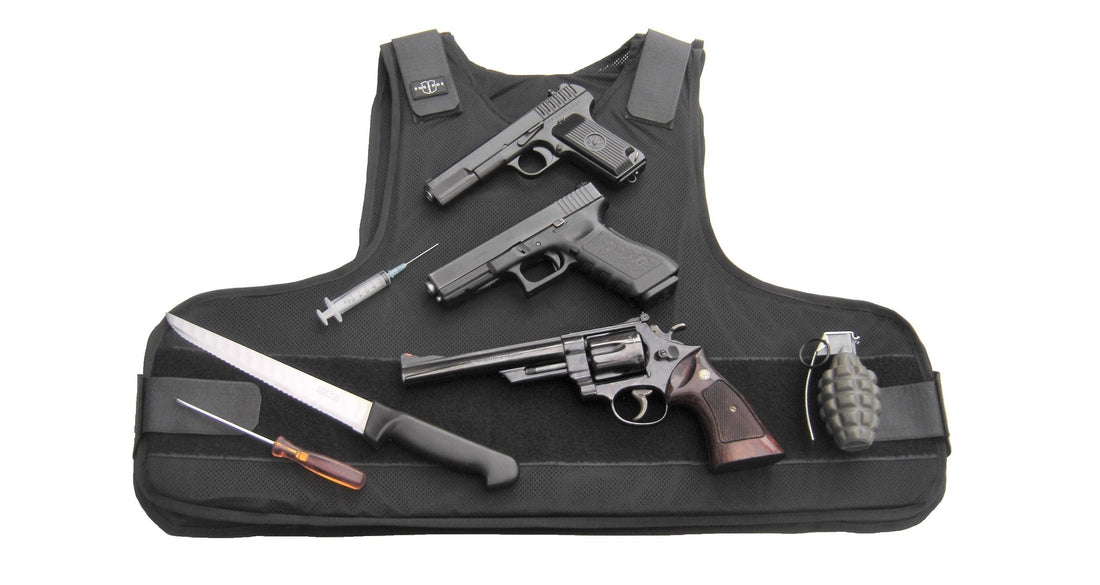
Bulletproof or bullet-resistant vest terminology, information before legally buying a bullet-resistant vest, tips on materials and clothing incorporating ballistic material.

Link to Deluxe FLEX-PRO bulletproof vest
Is it bullet-resistant or bulletproof?
The terms bullet-resistant vest or bulletproof vest sometimes cause confusion, but experts use the correct technical term "bullet-resistant vest". A bullet-resistant vest does not stop all bullets, only the bullets for which the vest was specially developed. The protection value falls under certain standards and classes. Technically, a bulletproof vest does not exist. However, a layman who wants to buy a bullet-resistant vest for the first time does not know the correct technical terms, various properties, standards, and classes, and therefore searches for "bulletproof vest" to find suitable protection. To better assist both the layman and potential customer, as well as the expert, we use both terms interchangeably.
Components of a bulletproof vest

Link to Deluxe MT-PRO bulletproof vest
The complete bullet-resistant or bulletproof vest

The cover, also called outer cover or carrier, is the outermost shell of the bullet-resistant vest. Depending on the intended use, various types of covers are available. There are discreet covers for wearing the bulletproof vest hidden under clothing, and there are overt or visible covers for wearing the bullet-resistant vest openly over clothing. Usually, two covers are purchased so they can be interchanged, allowing one cover to be washed while the other is worn. The cover is not bullet-resistant and therefore offers no protection against bullets!

The protective panel is the component that stops bullets or knife thrusts. The protective panel mainly consists of two parts, a front panel and a back panel, which are then placed in the specific front or back of the cover. The protection level is expressed in standards and classes, and depending on the perceived threat, the desired standard or class is chosen. There are also stab-resistant and bullet-resistant panels, or protective panels that offer protection against various types of threats. Inform yourself first or consult an authorized dealer of bullet-resistant vests before purchasing a bulletproof vest!

The complete bullet-resistant or bulletproof vest is what people normally buy or wish to have. This includes the protective panel contained within the desired cover. Together, they form the bullet-resistant or bulletproof vest. Therefore, pay close attention when buying a cheap bulletproof vest online. Many international sales platforms use various keywords interchangeably without really knowing their correct meaning. For example, cheap, usually Chinese, bulletproof vests are offered that are actually just the outer cover with a foam rubber filling that offers no protection whatsoever.
Material incorporated in a bullet-resistant vest.

For discreet covers, a sturdy cotton cover is usually used, optionally equipped with a special moisture-regulating and temperature-regulating mesh or Thermoliner® such as Coolmax®, Outlast®, Siocool®…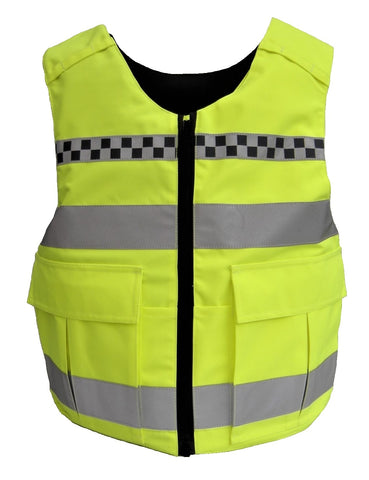 For overt or visible covers, a stronger material such as Cordura®, or another synthetic fabric, is usually used, optionally in a special color.
The American Kevlar® aramid fabrics have long been generally known to the public as bulletproof material; however, various fabrics are currently used as protective material in bullet-resistant vests. In Europe, Dyneema® from the Dutch manufacturer DSM® is most commonly used. Modern bullet-resistant vests also offer certain protection against knives and sharp objects, which means various materials are incorporated into the stab- and bullet-resistant vest.
Sizes

Depending on the manufacturer, bullet-resistant vests are made in various sizes. It is also true that adjustable shoulders and waist closures allow the vest to be adapted for a good fit. Tables are available from which the suitable size can be chosen after the potential buyer has measured their dimensions with a tape measure and compared them with the values in the size chart. The Dutch manufacturer Engarde® offers sizes from XS to 5XL. The Belgian manufacturer Sioen Ballistics® offers sizes from XS to 3XL with the option of a custom-made bulletproof vest for an additional charge (delivery time minimum 8 weeks).
Bullet-resistant clothing
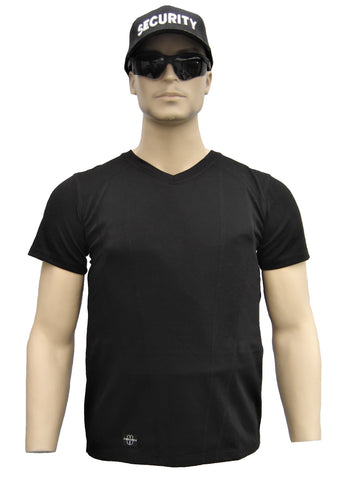
Bullet-resistant clothing is often misunderstood. A bullet-resistant shirt is not a thin shirt made of a thin, incredibly strong layer of bulletproof fabric! No, bullet-resistant clothing is where the outer cover looks like casual or stylish clothing, but in which special bullet-resistant panels are incorporated. The Engarde® bullet-resistant T-shirt
Link to Engarde bulletproof T-shirt FLEX-PRO
This Engarde bullet-resistant T-shirt looks like a casual T-shirt and is quite inconspicuous. Many event organizers prefer a security guard who looks casual rather than a security guard who looks as if an active shooter could strike at any moment.
This bullet-resistant T-shirt looks almost like a normal T-shirt, but is actually a cover in the shape of a black T-shirt with several compartments into which a standard Engarde® bullet-resistant panel can be inserted.
There are also other stylish garments that incorporate special bullet-resistant panels.
Standards and bullet-resistant protection against what?

Class NIJ-2: Bullet-resistant vests according to the American standard NIJ in class 2 are thin, light, and flexible to wear. They are easy to conceal invisibly and are particularly popular with ladies because they conform well to the body shape. They protect against all small pocket pistols, standard 9mm pistols, and revolvers in .357 Magnum caliber. The stab protection is minimal but still useful!

Class NIJ-3A: Bullet-resistant vests according to the American standard NIJ in class 3A are the most common soft bulletproof vests. Please note, however, that there are different versions of class 3A, some with knife protection or other stab-resistant properties. Class NIJ-3A (0101.04) is still the most sold protection level and protects against 9x19mm pistols and against heavy .44 Magnum revolvers. There is also an NIJ-3A (0101.06) standard which is slightly heavier and certified against the slightly more powerful .357SIG and .44 Magnum calibers. The stab protection against knives or sharp objects depends on the composition of the bullet-resistant panel. Not all 3A bullet-resistant vests offer the same stab protection.

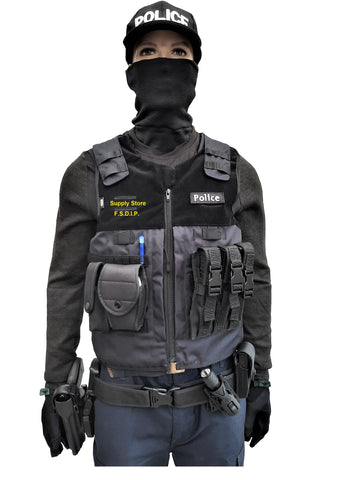
The old Russian 7.62x25mm Tokarev pistols were massively smuggled into Europe via the Balkans and former Eastern European countries, to such an extent that they pose a real threat to Belgian police officers
Link to Police bulletproof vests
who have added the 7.62x25mm caliber as a required protection for police bullet-resistant vests. The 7.62x25mm caliber is a small but powerful caliber that the old certified NIJ standards did not account for. This means that one cannot simply assume that all NIJ-2 or 3A bulletproof vests can stop the 7.62x25mm caliber. Only a limited number of bullet-resistant packages have been officially tested and certified to protect against these 7.62x25mm Tokarev pistols.

All Engarde® FLEX-PRO bullet-resistant vests are 7.62x25mm Tokarev resistant.
All Sioen Ballistics® HO1 and HO2 bullet-resistant vests are 7.62x25mm Tokarev resistant.
Bulletproof vest class 4 against assault rifles
Often, the layman does not know what weapons a bulletproof vest protects against. Generally, soft flexible bulletproof vests offer protection against knives, pistols, and revolvers. If you want protection against assault rifles, you need hard ballistic plates.

Link to class 4 bulletproof vests
Hard ballistic plates are slipped into a special compartment of the cover in the bullet-resistant vest. There are two different types of hard ballistic plates. ICW (In Conjunction With) ballistic plates must always be worn over a soft ballistic panel and are generally thinner (+/- 18mm thick). Stand Alone ballistic plates are thicker (+/- 28mm thick) and absorb the bullet within the plate. They do not need to be worn over a soft ballistic vest but can also be worn over a T-shirt or combat shirt.

Link to plate carriers class 4
Stand Alone hard ballistic plates are typically worn in a plate carrier and provide high protection against assault rifles. The most common dimensions are 250x300mm, but there are also small side plates and larger ballistic plates.

The most common protection levels are NIJ-3 (III) and NIJ-4 (IV). Here too, special additions are possible.
Generally, NIJ-3 hard ballistic plates offer protection against rifle bullets with a soft lead core. There may be additions such as NIJ-3+, which means tested against the Russian caliber (7.62x39mm Mild steel core) soft steel core from the AK47 Kalashnikov rifle.
Usually, for military plate carriers, hard ballistic plates of class NIJ-4 are used, which then offer protection against 7.62mm bullets with hard steel core from most assault rifles.